%201.webp)

What is Industrial Analytics? Tips and Examples
Find out why industrial analytics is so important, what are its potential benefits and how to leverage the power of IA in the most effective way possible.
Summary
With widespread use of smart sensors, IIoT devices, and AI/ML technologies, industrial analytics has evolved into one of the most crucially important components in a modern industrial automation ecosystem. Let’s find out why industrial analytics is so important, what are its potential benefits and how to leverage the power of IA in the most effective way possible.
Intro
Quickly unfolding shift to digital transformation and Industry 4.0/5.0 technologies creates an abundance of new opportunities for industrial organizations to improve the efficiency of their operations and optimize work processes. One of them is capacity to leverage the capabilities of a new generation of advanced industrial analytics solutions, fueled with data generated by a multitude of smart sensors and Industrial Internet of Things (IIoT) devices, and powered by AI/ML and other technologies that enable fast processing of Big Data and automatic generation of reports based on it.
In this article we are going to talk about industrial analytics in detail, providing its definition, describing the technologies that are typically used as part of industrial analytics solutions, and providing tips and recommendations on how to implement an industrial analytics platform within your organization.
What is industrial analytics?
Industrial analytics is an umbrella term that refers to a variety of processes and applications related to retrieving, combining, and analyzing time series data collected from industrial systems, hardware components and operations. As well as utilizing this data to improve the efficiency of industrial processes.
Industrial analytics is a type of advanced analytics related to using operational data and enhancement of industrial processes. It includes software tools, methods, techniques, and components integrated into existing industrial automation solutions to enable data collection, storage, modeling and analysis.
What is advanced analytics?
Advanced analytics is a term for various technological solutions and methods of analyzing Big Data. Its general purpose is extracting new patterns and business insights which can be utilized in various industries and processes.
Advanced analytics relies on innovative technologies such as AI (artificial intelligence), ML (machine learning), data visualization and modeling tools, neural networks, intelligent forecasting, real-time event analysis, semantic analysis and others.
The essence of advanced analytics lies in using Industry 4.0/5.0 tools to quickly and efficiently collect and combine data from multiple sources in order to analyze it and produce insights into business operations, manufacturing processes. industrial automation environments, economy conditions, market demands, etc.
The most common and popular types of advanced analytics are:
- Industrial analytics
- Predictive analytics
- Manufacturing analytics
- Data mining
- Prescriptive analytics
- Big Data analytics
Since we already defined what industrial analytics is, we’d also like to briefly explain what are the other types of advanced analytics, how they are different from industrial analytics, and in which areas of business operations these fields of data science overlap.
What is predictive analytics?
Predictive analytics is a type of advanced analytics that is probably the most commonly used by businesses and other organizations across various industries and market niches today.
Predictive analytics solutions rely on analyzing historical business data to predict future results and business outcomes. This method of advanced analytics typically relies on innovative analysis technologies such as machine learning, deep learning, AI, data mining, and predictive modeling. These tools are used to identify trends and patterns in various datasets that are typically way too large to be utilized for human analysis.
Predictive analytics typically includes predictive monitoring and predictive maintenance. The datasets used in predictive analytics are usually extracted from various business software systems. Most commonly, these systems are ERPs, CRMs, accounting and financial management tools, project management, inventory management, and other parts of business technology stacks that maintain their own databases.
What is manufacturing analytics?
Manufacturing analytics is a type of advanced analytics that relies on AI and ML-based algorithms to produce insights, patterns and other information that can be used to improve the efficiency of manufacturing operations and quality of the final products manufactured as a result.
Proper application of manufacturing analytics enables, simplifies, and streamlines the retrieval, storage and processing of data from various manufacturing systems, equipment, machines, processes, etc.
The application of innovative manufacturing analytics solutions allows companies to optimize the quality of manufacturing and production processes, remove errors and bottlenecks in manufacturing systems, and identify areas that need improvement, implementing quick and timely response to accidents, malfunctions, defects, and machinery failures.
What is data mining?
Data mining describes all activities and solutions focused on the discovery of specific knowledge and insights in all kinds of operational datasets. Data mining, typically enabled with AI/ML algorithms and statistics, allows companies to come up with trends and patterns retrieved from datasets that are typically generated by various software systems and machinery throughout the organization’s internal IT infrastructure.
Data mining is considered to be a key part of industrial and data analytics as a whole. It is a core discipline of data science. Knowledge discovery in databases (KDD) is a similar data science technique that is also used in collection and processing of data, but KDD and data mining are two distinct methods.
What is prescriptive analytics?
Prescriptive analytics is another type of advanced business analytics that analyzes data to generate best business decision options, recommendations for optimal courses of action, risk mitigation, business opportunities, and other data-driven decision-making purposes.
Prescriptive analytics often relies on machine learning (ML) and artificial intelligence (AI) algorithms to process and analyze large volumes of both machine-generated and user-generated data.
What is Big Data analytics?
Big Data analytics describes a process of examining large datasets to identify information that can be used for making well-informed business decisions and optimize operational processes within an organization. Such information includes various kinds of data correlations, market and business trends, changes in customer sentiments, and other patterns that are hidden and can be extracted out of available data.
Big Data analysis solutions typically use complex tools and applications that include statistical algorithms, predictive models, and other forms of advanced business analysis.
Why is industrial analytics important?
The main purpose of industrial analytics is helping companies and organizations to unlock the potential and value out of enormous volumes of data that is typically generated and stored within their IT/OT infrastructure. The insights acquired with industrial analytics solutions can be used in a variety of ways: to improve quality of products, mitigate risks and errors in manufacturing processes, implement more effective workflows and approaches, boost efficiency of operations, cut costs, reduce waste, minimize the consumption of resources and energy, etc.
Benefits of industrial analytics
Here are some examples of gains and benefits organizations and industrial teams can expect to achieve as a result of proper implementation of industrial analytics solutions.
- Discovery of new market opportunities.
The analysis of data collected throughout the industrial machinery and operations can lead to the discovery of new market opportunities, identification of advantages over competition, trends, and other insights that can be used to improve the overall state of affairs in your organization.
- Early detection of production errors and malfunctions.
The analysis of data collected from industrial machinery, IoT devices, software systems, robotics solutions and other pieces of equipment can lead to an early discovery of production errors. Such errors can then be eliminated, improving overall effectiveness of industrial operations. Additionally, based on the historical data about errors, wear of equipment, and machinery malfunctions, industrial analytics solutions are able to predict future problems, suggesting ways to avoid them.
- Reduced downtime and extended machinery life cycles.
Predictive maintenance is another major benefit of industrial analytics solutions as they can provide the data which can be used to adjust equipment maintenance schedules. Smart usage of predictive maintenance functionalities leads to extended life cycles of industrial machinery, significant reduction of machinery downtime, and overall boost of efficiency throughout all industrial operations.
- Insight into industrial operations.
Industrial analysis of data produced by machinery and other technical equipment and captured by IoT sensors embedded into these machines can provide an organization with a previously unseen level of insight into their operations. In some cases, the analysis of data collected by sensors is the only way to examine the functionality of certain machinery components that are not available otherwise as they are impenetrable.
- Reduced consumption of energy and resources.
Monitoring and assessment of how raw materials, energy and other resources are used is also possible with industrial analytics platforms. This allows organizations to identify ways to reduce consumption of these resources, cutting costs and increasing revenues.
- Increased equipment availability.
24/7 monitoring of equipment performance and improved maintenance makes it possible to increase equipment availability. This, in turn, increases throughput of production lines and allows the facility to manufacture more goods during the same period of time.
- Innovations and solutions to improve production performance.
Thanks to advanced analysis, especially when it is performed in real time, organizations acquire new opportunities to introduce innovations and improve the performance of all industrial systems and solutions, as well as regular employees and software.
- Improved quality of products and industrial processes.
The ability to drive up the quality of goods produced by a manufacturing facility and industrial processes that it has to maintain is one of the core benefits of proper utilization of industrial analytics tools and solutions. Customer satisfaction and brand loyalty should also increase as a result of these processes.
- Optimized supply chain management.
More effective management of processes related to the supply chain management allows organizations to streamline the flows of materials and resources, resulting in another area of improvement that would have a direct effect on overall plant performance.
- Reduced risks of poor business decisions.
With a steady supply of information generated by an advanced industrial analytics solution, company managers and stakeholders have better chances to avoid taking bad business decisions, which can lead to serious problems, devastating losses and in some cases even bankruptcy of the whole enterprise.
- Minimization of costs.
Finally, one of the most fundamental benefits of a high-functional industrial analytics solution is that it provides an enterprise with insights and tools to minimize costs across all operations and business processes, leading to increased financial stability and higher revenues.
Data producers and consumers
There are four major kinds of data producers and consumers (systems and human users who generate and/or use data) in the industrial analytics environments.
Processes
Various kinds of industrial processes typically are the largest producers and consumers of data. They include processes in machinery and manufacturing equipment, background IT infrastructure resources, engineering processes, sales processes, etc.
Products and devices
The other major type of entities that are actively both producing and consuming data are various kinds of products that operate as part of an industrial automation environment. They include computer hardware, electronic machines, robots, drives, injectors, and various other kinds of electrical appliances.
Humans
Human users also actively produce and consume data within industrial automation networks. This category includes all types of human users, most frequently organization employees, company partners, and customers.
Third parties
Finally, this category is reserved to other kinds of human actors and digital resources that are consuming and producing information within the enterprise IT network. Most often, third parties include various additional parties that are involved in the enterprise operations but are not a part of the company, such as suppliers, third-party contractors, payment providers, etc.
Data governance roles
Talking about data producers and consumers within industrial analytics environments, let’s also cover the main organizational roles that are typically responsible for data governance, data strategy and other key functions as part of an industrial analytics project.
Data engineers
The main function of a data engineer is to prepare the data for analysis by developing and implementing the appropriate pipelines across machinery, equipment, software, and data warehousing infrastructure.
Data owners
Data owners are typically responsible for certain types of data, such as data extracted from specific systems or machinery as well as data generated in a certain format. Responsibilities of a data owner is to make sure the data is secure, compliant with the appropriate rules and regulations (both enforced inside the enterprise and issued by the government bodies), and up to a high quality standard.
Data stewards
Data stewards usually play a similar role to data owners with the difference between these two being that data stewards are responsible for a more general oversight of data assets and the data generated and stored within an organization for subsequent processing by an industrial analytics solution.
Data scientists and data analysts
The purpose of data scientists and data analytics is performing the actual industrial analytics or, in other words, applying data models and algorithms to process the available data and come up with valuable business insights and other discoveries.
Data strategists
Data strategists are responsible for defining and executing the industrial analytics process strategy, both short-term and long-term. The key components of a successful industrial analytics strategy would be well-planned and well-structured data governance and data management rules, established core goals and objectives of an industrial analytics project activity, conditions for generating real and measurable business value from data, as well as other elements related to the development of data-driven solutions and business models.
Even though the roles of data owners, data strategists, data stewards, data engineers and data scientists do frequently overlap, each of these positions plays a unique role within an industrial analytics environment.
Data sources
Analogously to data producers and consumers, four basic kinds of data sources are defined in industrial analytics environments. They are:
Enterprise data sources
Enterprise data sources are all software systems within the enterprise OT/IT network that generate and transmit data. They include SCADAs, ERP systems, MESs, CRM solutions, computer-aided design (CAD) systems, PLM (product lifecycle management) tools, etc.
IoT data sources
This category comprises all types of data generated by physical machines, hardware and other IoT-connected devices within an industrial environment. Naturally, this category includes the information obtained from the whole variety of sensors interpreted into industrial machinery, robotics solutions and various other devices all of which are integrated into an IIoT network.
User-generated data
As opposed to the information produced by software and hardware systems, there is user-generated data, which is produced by human users, most often employees of the organization implementing industrial analytics solutions.
Web data sources
Finally, there are web data sources which comprise all types of acquired by industrial analytics solutions from the Web data that is not user-generated data. This category typically accounts for various databases obtained by an organization from third-party web sources, both private and public. Most frequently, these are public databases provided by government entities, openly available scientific data, or private databases created by specialized companies as a product to offer to industrial enterprises.
Industrial analytics applications
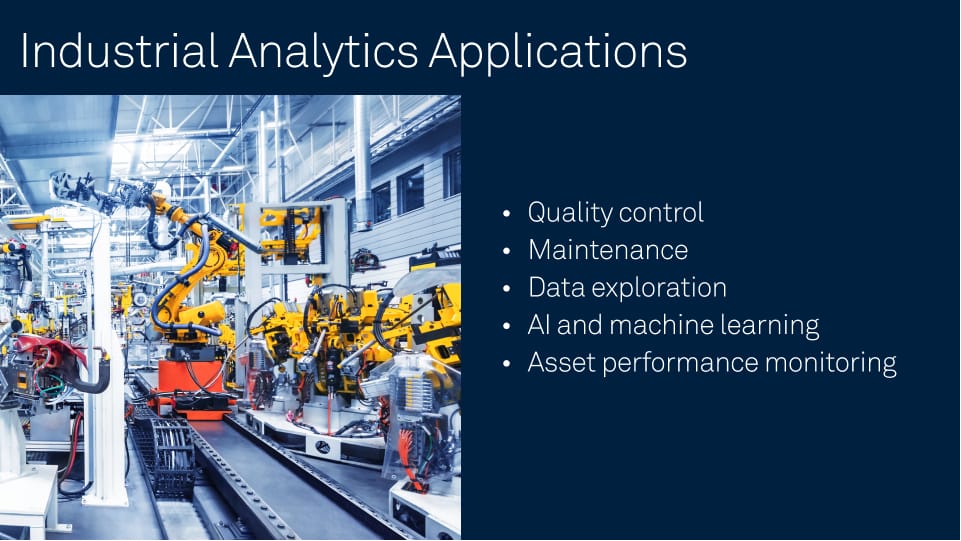
Industrial analytics solutions can be applied to achieve various goals and purposes within an organization. Let’s review some of the most common applications of advanced analytics solutions within industrial environments.
Standard and OLAP reporting
Standard and OLAP reporting is one of the main applications for industrial analytics. OLAP stands for Online Analytical Processing. It is a database technology design for quick and easy querying and reporting. OLAP is often used for planning, financial reporting, budgeting, sales reports and forecasts, identification of market trends, multidimensional analysis of metrics, etc.
Products such as Microsoft SQL Server's Analysis Services and Microsoft Excel include some features that enable OLAP reporting. The most common and popular specialized OLAP software platforms are: Oracle OLAP and Oracle Essbase, Apache Kylin, IBM Cognos, Micro Strategy, and Palo OLAP Server.
Quality control
Quality control is quite a common industrial analytics application scenario in modern-day manufacturing environments. Advanced analytics solutions can detect resource wastage, excessive energy usage and other issues causing quality problems. The implementation of advanced industrial analytics solutions can help to identify root causes of quality issues and prevent them from occurring in the future, reduce resources and energy usage, and suggest other improvements that would result in boosting the quality of production processes.
Preventive maintenance
Preventive maintenance (also sometimes being called proactive maintenance even though they are not the same thing — preventive maintenance is considered to be a sub-discipline of proactive maintenance) is focused on performing periodical maintenance tasks. The schedule of periodic maintenance is determined by an industrial analytics system after processing historical data related to operations and wear of industrial equipment.
Some examples of preventive maintenance of industrial equipment include routine inspections, lubrication, regular replacement of machinery components that tend to get worn out most quickly, capital repairs and overhauls, etc.
Predictive maintenance
Predictive maintenance is another sub-discipline of proactive maintenance focused on using industrial analytics to reduce unplanned downtime and accidental failures of equipment by calculating the most suitable time to perform maintenance tasks based on historical data.
Predictive maintenance allows industrial facilities to come up with more effective schedules of machinery operations, maintenance planning and other processes related to supporting industrial equipment in an active operational state. Proper utilization of industrial analytics for predictive maintenance needs allows organizations and manufacturing facilities to achieve a significant reduction in equipment downtime (up to 25%), minimize inspection costs, reduce maintenance costs, and prevent unexpected one-day stoppage of machinery or other critical parts of industrial infrastructure.
Data exploration
Data exploration is one of the initial stages of the analysis of any dataset, performed to understand the content of any given dataset and characteristics of data in it. In the case of industrial analytics, data exploration is used to explore the data generated by various industrial machinery and IoT sensors, visualize it and decide on how to utilize this data to gain maximum benefits. Which is why adopting a powerful and advanced data intelligence platform should be one of the cornerstones of a successful industrial analytics strategy.
Clarify is an operational intelligence platform that can augment your data analytics infrastructure and enable you to properly utilize process manufacturing data collected over the years. Regardless of your data management requirements, the Clarify platform is a versatile solution that can be used as a universal intermediary tool, solving challenges with processing, integrating and visualizing time series data across industrial automation systems and software components.
Want to see the capabilities of the Clarify platform with your own eyes? Take a tour.
Data mining and machine learning
Data mining is the next step in utilizing industrial analytics to uncover insights from data generated by machinery, software systems and human users. Today data mining is typically executed with the help of machine learning (ML) and deep learning solutions, as well as various other methods such as clustering, classification, regression, descriptive and diagnostic algorithms, association rules discovery, etc.
For data mining in modern days, the so-called machine learning operations (MLOps) platforms are commonly used. Some of the most popular and commonly used MLOps platforms are Amazon SageMaker, Algorithmia, Azure Machine Learning, Domino Data Lab, Google Cloud AI Platform, HPE Ezmeral ML Ops, Valohai, H2O MLOps, MLflow, and Cloudera Data Platform.
Asset performance monitoring
Asset performance monitoring is another popular application of advanced analytics solutions in industrial environments. Industrial analytics platforms can be set to track and monitor the performance of machinery, equipment, software systems and other enterprise assets based on a selection of preset KPIs. Specifically, industrial analytics solutions can track levels of waste, overall equipment effectiveness (OEE), production counts, asset downtime, etc. Proper application of automatic asset performance monitoring can lead to prolonged life cycles of industrial equipment, increased efficiency, higher production levels and other considerable benefits.
Yield optimization
Automated industrial analytics systems can also be used for control of various manufacturing processes, optimizing throughput and increasing yield. Analytical solutions based on advanced ML-based algorithms are able to track high-speed manufacturing processes in real time, generating insights and solutions that will help to lower production costs and optimize yield when integrated into the facility operations.
Industrial analytics market
According to a recent study conducted by Meticulous Research, the industrial analytics market is expected to grow at a CAGR of 16.6% from 2022 to 2029, reaching $55.3 billion by 2029.
Expansion of the industrial analytics market is fueled by increasing adoption of digital transformation and Industry 4.0/5.0 technologies, as well as IoT (Internet of Things) and IIoT (Industrial Internet of Things) solutions by organizations and businesses across various industries and market fields.
Each of the above generates enormous volumes of data, from information collected by sensors. machine vision solutions, PLCs, and other tracking components integrated in industrial machinery and equipment to logs, records and alters retrieved from various software systems and solutions that are part of the enterprise IT infrastructure. The ability to extract actionable business insights from this data becomes a crucial business factor that allows enterprises to get a major advantage against competition.
The adoption of robotics and various RPA (robotic process automation) solutions is another factor fueling the intense generation of new industrial Big Data that needs to be processed and analyzed by advanced next-gen industrial analytics platforms.
Additionally, industrial teams and companies today are rushing to adopt 5G-based networks and technologies that also deliver multiple considerable strengths, allowing them to leverage high-speed Internet connections, extremely low latency, better security and other strengths of 5G technologies.
Impact of COVID-19 pandemic on industrial analytics market
Naturally, the global COVID-19 epidemic, which originated in China in late 2019 and spread across the world by early 2020, also had a significant impact on development of the industrial analytics market. Various lockdown restrictions and economic turbulence that occurred as a result had a significant impact on industrial operations, causing falling consumer demand, supply chain disruptions, material and employee shortages, trade restrictions, etc.
However, all these problems additionally fueled the growth of the industrial automation market, stimulating companies to adopt innovative technologies to boost efficiency, implement resilient remote operations, optimize manufacturing processes and cut costs. According to one market study conducted by Mordor Intelligence, 80% of companies in the agricultural sector are planning to adopt at least one IoT project in the next three years. The adoption of IoT and IIoT technologies forces companies to also implement industrial analytics to take advantage of data generated by IoT sensors and other devices that are part of industrial IoT networks.
Industrial analytics market by economy sectors and geographic locations
According to the market study conducted by Meticulous Research, the oil and gas sector was the largest user of industrial analytics solutions in 2022. High demand for industrial analytics in oil and gas is explained by the need to integrate industrial automation technologies to monitor the supply of oil and gas, improve the efficiency of exploration operations, track the performance of critical infrastructure components, conduct research and other needs.
However, in the course of the period from 2022 to 2029, the pharmaceutical sector is expected to show the highest growth rate. Other market segments that should be among the most active adopters of industrial analytics technologies during the forecast period are automotive industry, food and beverage, consumer goods, electronics and semiconductors, and industrial machinery.
When it comes to the adoption of industrial analytics technologies by geographical locations, the Asia-Pacific region is expected to account for the highest growth rate during the forecast period, while North America, dominated by the United States, will have the largest market share.
Largest players of the industrial analytics market
Given such a rapid growth of adoption and high demand for industrial analytics solutions from companies across virtually all economic sectors, it is easy to see why the competition in this market is quickly growing as well.
Here are the biggest and most well-known players of the industrial analytics market:
- Cisco Systems
- Intel
- Amazon
- Oracle
- General Electric
- IBM
- Hewlett-Packard
- Microsoft
- Industrial Analytics GmbH
- Genpact
Latest trends in industrial analytics
As we said above, the widespread global COVID-19 pandemic ended up additionally fueling the demand for industrial analytics solutions and growth of this market. Let’s take a look at the most significant and important trends of the industrial analytics market you should be well-aware of in 2023 and looking further ahead.
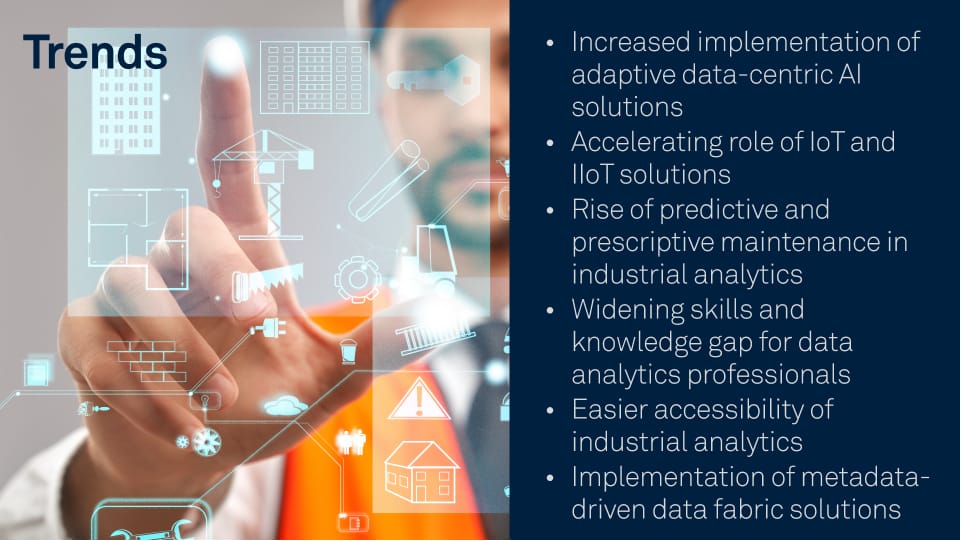
Increased implementation of adaptive data-centric AI solutions
It would not be an overstatement to say that AI adoption today is a key trend in the majority of technology fields and market niches. Naturally, the industrial analytics field is not an exception.
Gartner expects that in the next several years organizations and industrial teams will increasingly implement adaptive data-centric AI-based solutions to manage their data processing needs. “Without the right data, building AI is risky and possibly dangerous. As such, it is critical to formalize data-centric AI and AI-centric data,” said Rita Sallam, Distinguished VP Analyst at Gartner.
The advantage of using adaptive AI-based industrial analytics solutions is that they are more flexible, supporting fast changes and quick adaptation to changes and new settings. Data-centric AI tools enable a number of advanced features that are highly beneficial to utilize in modern-day industrial environments, including automatic labeling and filtering of raw data, elimination of data bias, support of highly diverse data processing, proactive metadata management, utilization of data fabric for automated data integration, etc.
Accelerating role of IoT and IIoT solutions
According to a report by McKinsey Global Institute, the economic value of the Internet of Things market in general could be worth between $3.9 trillion and $11.1 trillion annually by 2025. Accelerated implementation of IIoT (industrial Internet of Things) in industrial environments will play a major role in the development and utilization of industrial analytics solutions. The availability and widespread usage of IoT sensors will make it easier for industrial analytics teams to deploy solutions that will be able to deliver real actionable results with proven and measured business value.
Rise of predictive and prescriptive maintenance in industrial analytics
Predictive and prescriptive maintenance of machines will be the most popular application for industrial analytics solutions in the first half of the 2020s, McKinsey Global Institute estimates. According to their forecast, predictive and prescriptive maintenance of machines will be used by 79% of all enterprises that utilize industrial analytics technologies. The other two most popular applications for industrial analytics platforms will be customer/marketing-related analytics (77%) and analysis of product usage in the field (76%).
Widening skills and knowledge gap for data analytics professionals
The notorious IT talent gap continues to grow and cause significant problems to companies and organizations across various industries and market fields. Data science is one of the tech knowledge fields affected by it the most. According to Forbes, only 22% of organizations today have employees with sufficient skills to implement and maintain a functional industrial analytics solution. Naturally, such a significant gap in skills, knowledge and first-hand experience will inevitably be one of the biggest issues constricting further growth and development of the industrial analytics market in the years to come.
Accumulation of multiple use cases and other reliable data
One particular advantage of quickly growing adoption of industrial analytics solutions is accumulation of multiple case studies and various reports with reliable well-structured data. These reports showcase the benefits of implementation and utilization of industrial analytics technologies to gain real and proven business benefits.
More and more companies across various industries acknowledge the importance of data sharing as one of the main components of digital transformation, leading to increased collaboration, accelerated development of new technologies, optimization of architecture of industrial analytics platforms and data solutions, and other benefits for the market as a whole.
Easier accessibility of industrial analytics
As main technologies of the Industry 4.0/5.0 era, such as AI/ML, Big Data, IIoT and others, are getting more widespread and easier to access every month, it is logical to expect that various industrial analytics solutions will also become a lot more accessible than before.
Experts predict that quickly increasing demand for industrial analytics from organizations and companies across economic sectors and market niches will stimulate the suppliers of tools and platforms in this field to offer products that will be more flexible and scalable, being able to expand and shrink following specific customer needs and business cycles.
Another factor that is expected to contribute to democratization of industrial analytics solutions is the fact that products in this technology field will become more fragmented and component-based as opposed to complete and seamless industrial analytics platforms common today.
According to an estimation made by Gartner’s experts, in the near future, 60% of organizations will use analytics technologies that are composable. The ability to use components from multiple different vendors, combining them together into one custom platform, will make it easier for companies to build and implement highly functional and effective industrial analytics.
Implementation of metadata-driven data fabric solutions
Another major trend that needs to be mentioned is integration of metadata-driven data fabric solutions to enable more effective delivery and processing of information by modern-day industrial analytics tools.
Data fabric is a software architecture approach aimed at facilitating self-service data consumption and simplifying access to various kinds of data within an organization. Gartner describes data fabric as "flexible, resilient integration of data sources across platforms and business users, making data available everywhere it's needed regardless where the data lives.”
The term “metadata” can be defined as any data that is providing information about one or several aspects of the data. Or simply as “data about data.” Metadata is commonly used to summarize and organize the criteria for separation of vast amounts of data by types and formats.
Data fabric allows organizations to establish a single system that will be able to effectively access information from both on-premise and cloud storage to provide access to all data on various levels of enterprise infrastructure in real time and for multiple users at the same time. Utilization of data fabric solutions that are able to take a full advantage of metadata-driven capabilities will further enhance industrial analytics systems, allowing them to reach a new level of productivity and effectiveness.
Growing volume of synthetic data
A combination of contemporary trends related to continuously expanding digital transformation and Industry 4.0/5.0 technologies also fuels quick growth of synthetic data. Which, in turn, triggers accelerated utilization of this synthetic data by organizations to model market situations and predict outcomes.
Only recently the industrial analytics industry has come up with a more or less universally accepted conclusion that synthetic data can frequently have significant advantages over real-world data when it comes to modeling of market conditions and business situations.
Despite an expansive growth of Big Data infrastructure and environments over the last half a decade or so, many organizations still experience a noticeable and problematic lack of data to create predictive models in industrial analytics solutions. This is one of the main conditions that allow synthetic data solutions to deliver the desired performance.
The main widely accepted advantages of synthetic datasets over real-life data would be better quality of data, its better preparedness to be used by business intelligence and industrial analytics solutions, and fewer security-related concerns (since the compromisation of real-world data can be a general concern for many businesses and organizations, synthetic data typically has no confidential information in it).
Segmentation of data and analytics ecosystems by regions and vendors
Increasing introduction of regional data security laws and regulations across the globe will lead to further segmentation of D&A ecosystems by regions and vendors.
In order to comply with these rules, D&A ecosystem vendors will be forced to create regional ecosystems. Since this move would need to be executed by the industrial analytics vendors, it would lead to multi vendor market diversification. In case this scenario will fully come into reality over the next several years, this will force organizations to consider another criteria when selecting a market vendor: the level of regional D&A ecosystem supported by it.
Industrial analytics data platforms
Data platforms are a critical component of any industrial analytics system as they are responsible for the storage of data generated and transmitted by various parts of the enterprise industrial analytics network. A data platform typically plays a key role in the framework and architecture of a high-functional industrial analytics platform, enabling access to data and its fast processing.
There are four basic types of data platforms that are typically defined within industrial analytics environments.
Data lakes
A data lake collects and stores all the historical data across the industrial automation system components and infrastructure elements, including SCADAs, ERPs, and MES (manufacturing execution systems). The data is collected and stored in all native formats and structures — structured, semistructured, and unstructured. Utilizing a data lake enables companies to store the data from all the sources within their enterprise network in one place, allowing company employees to quickly find and access the information they need, perform the analysis and collaborate on it in real time. Data lake is a critical component of unified namespace (UNS), a software layer in the industrial automation system of the future, which acts as a centralized repository of all data collected from sensors, IIoT devices, machines, robotic solutions and other system components, as well as all its context.
Data warehouses
Data warehouses play a role that often looks confusingly similar to data lakes. Let’s clarify what is the difference between these two concepts. Data warehouse is a database that collects only relational data coming from line-of-business systems and applications, with the structure of data defined initially for fast SQL queries. A data lake, on the other hand, stores both the relational and non-relational data from all apps, devices, software and other sources within the organizational network. The structure of the collected data is not defined. Nowadays, data warehouse is a most frequent choice of a data platform for the majority of organizations that implement business intelligence and industrial analytics solutions.
Data catalogs
Data catalogs typically collect, store, organize and transfer various kinds of metadata generated by all types of IT systems across the enterprise network. The main purpose of a data catalog in a typical industrial analytics system is to make the connections between network nodes and enable quick operations with different kinds of metadata supplied by different data platforms (including data lakes and data warehouses) to be processed by an industrial analytics solution.
Data marketplaces
The fourth and final type of data platforms that are typically used in modern-day industrial analytics environments are third-party data marketplaces. Like all online marketplaces, they serve as intermediaries between consumers and producers. In our case, these are producers and consumers of data. Data marketplaces normally allow organizations that produce metadata and other kinds of datasets easily consumable by industrial analytics solutions to put them for sale. Enterprises that require such data are able to acquire it on a marketplace for subsequent utilization as part of their business and industrial analytics infrastructure.
Field-specific applications for industrial analytics solutions
Let’s look at the way industrial analytics solutions today are applied in specific and most common market fields and industries.
Manufacturing and industrial operations
Naturally, the manufacturing sector and companies engaged in industrial operations, such as oil and gas, energy supplies, chemical processes, metalworking, etc., are among the most active users of industrial analytics solutions today. These solutions allow them to gain a wide range of business bonuses, streamlining and boosting the speed of manufacturing processes, optimizing usage of industrial equipment and machinery, increasing machinery lifecycles due to better maintenance enhanced with predictive analytics, and so on.
Supply chains and logistics
Implementing industrial analytics to empower supply chain management operations allows organizations to optimize all the processes, identify areas for improvement, and make more informed decisions. With utilization of latest advances in AI/ML solutions and other innovative technologies, organizations can build industrial analytics platforms able to adequately predict market trends, risks, disruptions and other components of a supply chain operations, delivering multiple considerable benefits.
Retail
Industrial analytics tools and solutions also get increasingly more popular in the retail sector, among both online stores and companies running real-life stores and locations. Implementing industrial analytics instruments as part of their core operations allows retail businesses to make a number of noticeable achievements. Such as, mainly, gaining customer behavior insights, demand predictions, auto-generated inventory suggestions, and disruption warnings. Which, in turn, enables better sales, more efficient operations, optimization of processes, reduction of costs and a number of other well-measured improvements.
In the actual business environment, application of industrial analytics solutions by retail business leads to more personalized and effective marketing campaigns, better inventory selection, enhanced effectiveness of sales operations and other major business benefits.
Financial services
Another common application of modern-day industrial analytics solutions is processing of various kinds of financial data, from estimations and expenses reports to accounting books, receipts and taxation forms.
Even though the majority of industrial organizations are typically focused on using their analytical capabilities to process data related to manufacturing processes, IT and business operations, the analysis of financial data is also common application. Being processed, the financial data can be turned into reports and financial predictions, typically delivered in the form of interactive dashboards. This can enable organizations to cut a significant part of monthly/yearly expenses, reduce the costs of accounting and business operations monitoring, improve accuracy of financial plans and future predictions, etc.
Healthcare
In the healthcare industry, organizations are usually using multiprofile and specialized industrial analytics solutions to process various kinds of data, from electronic health records and person’s vital signs monitoring to pharmaceutical records, costs of producing and/or purchasing medical tools and compounds, patient behavior, and other. One of the key aspects that fuels frequent use of industrial analytics by healthcare organizations is typically strict confidentiality requirements due to government regulations and network connectivity needs.
Chemical industry
Chemical industry is among pioneers in the adoption of industrial analytics to automate multiple mundane operations and processes, improve safety, streamline processes and gain a boost in general performance. Most frequently, chemical organizations use industrial analytics to implement reliable and streamlined day-to-day operations and minimize risk of malfunctions and disruptions.
Construction
Construction businesses and organizations operating in this field are also actively adopting industrial analytics. These technologies allow them to establish more efficient management of equipment and utilization of resources, tacking of assets and processes, control of staff assigned to fulfill projects and project-related tasks, etc. With assistance of real-time monitoring, intelligent data analysis, and AI/ML-based predictions, construction companies are able to generate a lot more accurate project expenses predictions and avoid budget overruns.
Industrial analytics vs. enterprise analytics
When talking about uses and applications of industrial analytics by businesses and organizations across market fields and economy sectors, we need to clearly articulate the difference between two fairly similar notions: industrial and enterprise/business analytics.
The main difference between industrial and enterprise analytics is focus. Even though both types of solutions typically are based on the same software architecture and technologies, industrial analytics is mostly fueled with time series data and applied to process data related to production, manufacturing, supply chain and other aspects of solely industrial operations. This data is typically extracted from sensor-equipped machinery, IIoT network devices, robots and various software solutions used to automate, track and manage industrial operations.
Enterprise and business analytics solutions, on the other hand, are frequently used to process data collected from various nodes of enterprise IT networks and related to all levels of business operations, including marketing, sales, financial management, human resources, quality control and so on.
Data used by industrial analytics solutions typically is a lot more diverse, presented in different formats, spread across various data silos, and stored in time series databases.
This is why specialized industrial analytics platforms are usually tailored to work with data collected in time series format and stored by data historians, SCADAs (supervisory control and data acquisition systems), universal namespaces (UNS) and other data hardware typical for industrial environments.
Additionally, there are other key aspects that differentiate industrial analytics from platforms applied for wider enterprise analytics purposes. They are:
- Main purpose and goal.
Let's start from the fact that industrial and enterprise/business analytics solutions are typically designed for different goals and purposes. Industrial analytics platforms are mainly tailored to be able to recognize patterns in large datasets and come up with forecasts and predictions baked on this data.
- Ability to process extra-large volumes of data.
One of the most significant differences is in the size of data which industrial and enterprise analytics solutions are tailored to process. Industrial analytics platforms are typically developed to support the processing of Big Data that is truly Big. Industrial facilities typically generate data in huge volumes: in the petabyte-per-day or more range. This data comes from thousands of sensors attached to machinery and industrial equipment, information coming from Edge devices, data produced by various software systems hosted both on-premise and on the cloud, etc.
- Support of specific data formats.
Even though modern-day data analytics platforms strive for being universally convertible when it comes to data standards, industrial and enterprise analytics solutions still are typically customized for data coming in slightly different kinds of formats. Industrial analytics tools are designed to work with data transmitted through communication protocols that are most typically used in the industrial automation industry.
- Suitability for IoT and IIoT data processing.
As we said, usual enterprise analytics platforms typically are not designed to work with extra large volumes of data. In most cases, this is data coming from IoT and IIoT networks that can easily incorporate hundreds devices equipped with thousands of sensors. Industrial analytics solutions, on the other hand, are typically tailored to be able to process such data collected from various nodes of an IIoT network.
- Utilization of ML and AI technologies.
Another major distinction is the fact that industrial analytics solutions today rely on ML and AI models as part of their core data processing algorithm a lot more often. The need to effectively process huge volumes of versatile data, — structured, unstructured and semi-structured — that is typically supplied in different formats, is what drives accelerated implementation of AI&ML technologies in industrial analytics solutions.
- Approach to data processing.
By saying ‘approach to data processing,” we mean how requirements and goals for data analytics platforms and initiatives are defined. When it comes to enterprise and business analytics tools, they are typically focused on more descriptive and retrospective goals such as identifying trends and opportunities for improvement in organization’s workflows and processes. Industrial analytics platforms, on the other hand, most frequently are designed for proactive, prescriptive and predictive purposes, such as making predictions based on data from a number of sources or coming up with potential solutions to pre-specified industrial and operational problems.
- Human experts required.
Enterprise/business analytics platforms typically require a considerably larger team of experts to be involved in the project. Most commonly, they involve at least 4-5 people (often more) as part of the team directly running the project. People in the team may range from CIO, CDO and other top management roles to business analysts, data warehousing experts, and managers of analytics solutions. Industrial analytics solutions can easily be managed by just one or several people in positions such as business manager and/or data/business analyst.
Data analyst vs. business analyst
Since we mentioned data analysts and business analysts among main roles that typically handle the management of and data processing by industrial analytics systems, let’s clarify the distinction between these two roles.
- Business analysts typically do not perform deep analysis of data. They are focused on extracting general insights about problems in a company's operational processes and coming up with potential solutions to workflow issues based on this data. They work with data on a more general conceptual level, minding real business applications of the data gained as a result of analysis. Data analysts, on the other hand, are focused on performing deep technical analysis of raw data that is typically collected from a variety of sources, organizing and structuring it to be able to apply complex AL.ML and other modern-day technologies for data processing.
- Business analysts typically have specializations and experience in general fields and business operations such as marketing, e-Commerce, sales, manufacturing, etc. The knowledge of the main domain their company operates in allows business analysts to identify approaches to using enterprise analytics tools and issues they can help to solve. Data analysts, by comparison, normally just require specific expertise and experience in working with data that includes familiarity with industrial analytics solutions, databases, communication protocols and other core elements of effective real-time data analysis.
- Many business analysts actually have non-technical professional backgrounds. Most typically, they evolve into business analysis roles from positions in business management, economy, accounting, etc. By comparison, data analysts in most cases do require extensive technical knowledge and experience in tech fields, which include programming, databases, statistics, Big Data processing, data warehousing, algorithms, etc.
How to implement industrial analytics?
Now, as we covered the main theoretical aspects of industrial analytics, let’s dive a little deeper into the specifics of actually implementing these tools in industrial and process manufacturing environments.
Based on the extensive experience Clarify Team has in working with industrial analytics processing tools and relevant industrial data, here is a brief guide with key steps and recommendations we advise you to keep in mind when planning and executing your industrial analytics project.
Most typically in industrial automation environments, the process of implementing industrial analytics projects is divided into three main phases: forming a team and assigning roles, implementation of required IT architecture and infrastructure, and execution of industrial analytics processes. Let’s talk about each of these phases, and the steps you should take while going through them, in more detail.
Phase 1. Forming a team and assigning roles
Even though, as we mentioned above, in theory industrial analytics solutions can be operated by just one or several people (data/business analysts or frontline business managers), in most cases implementation of such a project would require a full-fledged team. Which itself can comprise several smaller teams, such as operation technology team, IT team, data analytics team, etc. Here are the key steps of forming an industrial analytics team and assigning roles in it.
- Identify key stakeholders and decision makers of the project.
The first logical step when preparing an industrial analytics solution implementation would be identification of key decision makers and stakeholders. These are the people who will be responsible for supervising and managing the project from its earliest stages to the end. Most often, people assigned into decision-making roles are top managers (CIOs or CTOs), plant managers, experienced data scientists, process engineers, production managers and other specialists with similar qualifications.
- Determine specific roles and responsibilities required as part of the project team.
When key stakeholders of the project are assigned, you can proceed to planning the structure of the future team. Determine which teams it should comprise, which roles and responsibilities should be included in each of these teams and so on.
Even though your particular project may not require all the teams described below, for the educational purposes of this guide we are going to describe the process of forming each of the four key teams that typically perform as parts of a larger industrial analytics project team.
- Form an IT team.
Naturally, information technology teams exist in the majority of organizations that operate in industrial and manufacturing environments performing various tasks, from software development and integration of various enterprise IT network components to maintenance of systems across the layers of IT infrastructure. When it comes to implementing industrial analytics projects, an IT team is typically required to develop software architecture and tools needed to support the collection and processing of data sent from various nodes of the enterprise network. Members of the IT team need to facilitate communication between other teams and organization employees, gathering requests and feedback to make sure all the right software tools, computing resources and hardware are available.
- Form an embedded analytics team.
Most typically in industrial automation environments, embedded analytics team members are responsible for the development, implementation and maintenance of software tools, applications and other infrastructure elements designed to facilitate streamlined collection, transmission and processing of enterprise data. In industrial analytics projects, embedded analytics team members are most frequently responsible for utilizing first-hand knowledge of their specific facility operations to identify key issues and areas to improve with advanced analytics technologies. They also collaborate with other teams ensuring data from embedded systems and applications is supplied and collected in real time.
- Form a data analytics team.
Members of the data analytics team are responsible for creating data models and deploying tools and technologies used by industrial analytics platforms to process data and identify insights, trends, generate forecasts and so on. Data analytics team members typically collaborate with embedded analytics members when deploying different layers of the industrial analytics platform and integrating it with other parts of the enterprise infrastructure.
- Form an operational technology team.
Members of operational technology teams are typically responsible for the maintenance and support of the industrial analytics platform as a whole and its separate components. They also participate in the integration of data silos across various layers of the facility network with industrial analytics solutions. As well as collaborating with the IT and data analytics team in the construction of infrastructure able to support a full industrial analytics cycle, from data collection to the delivery of final results and their utilization as part of business and manufacturing processes.
Phase 2. Building industrial analytics architecture and infrastructure
When the team responsible for project implementation is fully formed and all the roles are assigned, you can proceed to deployment of the appropriate architecture and infrastructure that will be able to support industrial analytics operations your organization requires. This phase includes the development and implementation of all technologies, infrastructure components, tools, modules and data silos that need to perform as part of your industrial analytics platform. Let’s talk about core architecture elements in more detail.
- Prepare data silos.
One of the first steps to take when preparing an industrial analytics project is to make sure your data is analysis-ready and available data silos don’t lock the data from being accessed by the industrial analytics platform. Pretty much any industrial or manufacturing facility with modern machinery and equipment generates huge amounts of data by default. This doesn’t mean, however, that this data in its raw state is ready to be processed by industrial analytics solutions. In order to be able to actually utilize the data generated by and collected from various nodes in the industrial automation network, you need to make a few key preparations:
- Convert the data into formats that can be processed by your industrial analytics solution.
- Make sure it is stored in an efficient, easily accessible and fast data storage space.
- Prepare and organize key data silos, remove or restructure those data silos that lock the data and don’t allow analytics solutions to access it.
- Augment your data with tags and/or other types of contextual information to make sure different kinds of information can be easily differentiated by an automatic industrial analytics solution.
- Implement necessary IT components.
IT components used as parts of an industrial analytics solution typically are specialized modules that facilitate communication between various endpoints of the system.
Here are some examples of such IT modules:
- Organizational (normalizing) module.
Organizational or normalizing modules are responsible for finding raw data stored in a data lake or data warehouse and converting it into appropriate time series formats that are supported by the industrial analytics solution.
- Mapping module.
A mapping module within an industrial analytics infrastructure is responsible for the contextualization of available data. It scans through log files and other types of raw data collected from various network nodes, automatically assigning them names, tags and other types of marks that help the system to organize and map available datasets.
- Aggregating module.
An aggregating module is responsible for identifying datasets and data silos of similar kinds and formats, merging them together for subsequent processing and analysis in batches for better performance and more accurate results.
- Processing module.
Processing modules are used to perform various data transformations within an industrial analytics system. Each processing module is typically responsible for one specific data processing function.
- Execution module.
Execution modules, also sometimes being called action modules, are typically used to execute specific actions that were activated by triggers. Some examples of such actions would be sending notifications and alerts to users, delivering reports, opening new system windows, etc.
- Implement data analytics components.
Naturally, various data analytics components always serve as core elements of any industrial analytics solution architecture. Here are some of the most common data analytics modules used in such systems:
- Data acquisition module,
- Data maturity evaluation module,
- Data governance and standards module,
- Roadmap and operating module,
- Data security module,
- Reporting module,
- Statistical processing module.
Implement embedded analytics components.
Embedded analytics models are typically applied as part of industrial analytics solutions to deliver the so-called operationalization of data processing models developed by data analytics teams in collaboration with IT teams. It means that embedded analytics components help to adapt and transform the approach to the analytics process in order to make the end-results suitable for immediate integration into actual operational processes of the organization.
Naturally, members of the embedded analytics team are typically responsible for the development and implementation of embedded analytics components of an industrial analytics platform. Their expertise is required to identify key topics and areas to apply the advanced analytics technology in order for it to come up with the best possible outcome.
In most cases, embedded analytics components are built with two basic communication endpoints to the core system infrastructure: outbound and inbound ones. In line with this architecture model, the outbound endpoint is responsible for the access of an embedded analytics component to the computing resources that power the whole system. The inbound component is used for real-time delivery of the models deployed as part of an industrial analytics platform.
Phase 3. Industrial analytics utilization
The third phase presents actual execution of a deployed industrial analytics solution to adjust real-life business operations of an industrial facility or organization. Even though there is no single specific sequence of actions to take when using an industrial analytics platform, here is a list of actions and processes that typically serves as a general standard for teams who start utilizing newly deployed industrial analytics platforms:
- Determine key issues and areas of interest to apply the capabilities of an industrial analytics solution to.
Obviously, this step requires a joint effort by all project teams and individual members so an extensive collaboration would be required to deliver the best possible results. An embedded analytics team typically plays the most important role during this stage. The key goal is to identify specific areas of business operations and objectives to focus your industrial analytics solutions on.
- Research your data needs and check the data availability.
The next logical step is always to check if you have the right data available for processing in order to come up with insights usable to deliver real improvements of operational processes when implemented as part of day-to-day workflows. If the data is available, you should also check its accessibility or, in other words, if it supports the structure and formats of data that can be effectively processed by your industrial analytics solution.
- Set up and integrate relevant data silos into the industrial analytics solution.
Since in the absolute majority of cases organizations don’t have the required data right off the bat, they have to proceed to preparing relevant data and integrating the right data silos into the system in order to be able to execute data analytics models created by the industrial analytics platform team.
- Structure the data to prepare an analysis-ready dataset.
When the data silos are established and integrated into the system, the team still needs to work with the raw data supplied through these streams to clean and structure it, organizing into the formats that are consumable by the industrial analytics solution.
- Creation of data-driven models.
When the end-data is prepared for effective utilization by the system, the team can proceed to creating models to use as a core structure driving the process of data analytics to come up with actionable results.
- Activation of the analytics process.
The final step is actual execution of all industrial analytics infrastructure based on developed models and fueled by the ingested data to come up with operationalised results or data suitable for immediate integration into actual operational processes of the organization.
Common issues and challenges
Naturally, there is no lack of typical issues, bottlenecks and challenges the majority of organizations that implement industrial analytics solutions are facing. Let’s briefly stop on each of the most common problems that occur with industrial analytics projects.
Failure to make the data accessible to industrial analytics algorithms
Even though a large share of currently operating industrial operations are already generating vast amounts of time series data, don’t make a mistake of thinking that this data can be processed by an industrial analytics solution right away. Because, in the majority of real business cases, this is just not true. Many organizations that have implemented an industrial analytics solution face noticeable challenges when it comes to applying existing data silos to extend valuable business insights from it.
Failure to build a qualified team to execute the project
Another very common fundamental reason why many industrial analytics projects end up failing to deliver true and measurable business results is the fact that many organizations fail to build a team of employees with the right skills and knowledge required to be able to actually execute an industrial analytics platform deployment project. Needless to say, when the team, especially its decision-making part, doesn’t have people with proper understanding of industrial analytics and technical aspects of its implementation, the project often ends up problematic and short to deliver.
Failure to identify right applications and types of information to extract
In many cases, inability to identify the right applications and areas of implementation for a newly implemented industrial analytics solution becomes the decisive factor that has a critical impact on overall performance of the industrial analytics platform.
Weak data protection and enterprise cybersecurity infrastructure
Full-scale and technologically advanced cybersecurity infrastructure is something that many organizations implementing industrial analytics tools frequently overlook. And this is one of the main reasons why they end up having information security incidents, from accidental leaks of sensitive corporate data to targeted hacker attacks with devastating effects on company infrastructure and business operations.
Failure to digitize the right data and operations
The first most fundamental prerequisite an organization needs in order to be able to derive any value from industrial data is having it (the data) in digital form, regardless of the format and structure. The fact is, many companies operating with heavily outdated industrial and manufacturing machinery fail to solve the issue of digitizing the data. The main reason would be the need for considerable financial investments spent on a modernization of their industrial equipment and machinery.
Failure to implement edge computing infrastructure
Modern-day industrial analytics solutions on many levels are built on top of edge systems that enable fast processing of data and other computing operations performed in real-time or near real-time mode. Utilization of edge computing technologies and architectures allows organizations to establish better cybersecurity protection of their sensitive information while achieving truly fast data processing and analysis. However, implementation of a full-scale edge computing infrastructure can be a challenging and resource-demanding task. This is why many organizations either decide to postpone the implementation of edge computing projects or fail to execute them properly. And the absence of edge computing infrastructure leads to various challenges in performing industrial analytics and poor results of such projects.
Failure to account for influential external factors
“Working in the field of high performing, power intensive assets is always a challenging environment due to the dependencies on external factors such as energy prices. The energy crisis evolving in the beginning of 2022 has definitely had its influence on our work,” said Florian Stark, Head of Business Development & Sales at Industrial Analytics IA GmbH. He is right. Failing to account for influential external factors in industrial analytics models often leads to poor results as forecasts and predictions generated by AI/ML-based systems don’t deliver desired and measurable results business-wise.
Failure to utilize support and resources of the advanced analytics industry
The success of an industrial analytics solution to a considerable extent always depends on the ability of the organization deploying it to utilize the full power and support of the advanced analytics industry. For example, some organizations fail to establish a partnership with the suppliers of their machinery and equipment. When it comes to industrial automation environments, you should realize that proper collaboration with the OEMs (Original Equipment Manufacturers) can make it much easier for an organization to implement and maintain a functional industrial analytics platform. Additionally, it is easy for an organization to overlook various services, offers and resources that can make it much easier for them to achieve the desired goals and objectives of their industrial analytics projects.
Failure to educate and upskill current employees
Another thing you need to understand clearly is that industrial analytics solutions rarely, almost never really, exist separately from the whole IT infrastructure, corporate environment and digital education level of the workforce. This is why industrial analytics projects typically deliver best results when implemented as part of larger digital transformation, digital factory and Industry 4.0/5.0 implementation initiatives. When it is not the case, and the level of digital culture among employees is not very high, industrial analytics solutions typically perform a lot less effectively. It isn’t uncommon for organizations to fail to provide and enforce the right education to their employees in order to reach the level of skills and computer system knowledge sufficient enough to leverage capabilities of advanced analytics in full.
Failure to implement and properly utilize digital twins models
Digital twins technologies and the ability to properly utilize them is one more common element of success when it comes to using industrial analytics solutions. When an organization has a full and detailed digital twins environment that includes copies of all major machinery, equipment, systems and other industrial network elements, this makes it much easier for an industrial analytics platform to come up with accurate estimates and predictions, especially in the predictive and prescriptive analytics field. Unfortunately, many organizations fail to implement a truly functional and useful digital twins environment which leaves them without a strong leverage in operating industrial analytics models.
How to choose an industrial analytics solution?
There is a great variety of software solutions and components that can be used as part of an industrial analytics system. Naturally, this makes it a bit difficult to choose the software that would be best fit for your needs and requirements. Here is a list with a few key questions you should ask yourself when selecting an industrial analytics software tool that we come up with based on the extensive experience in industrial analytics the Clarify Team has acquired over the years.
- How compatible is this software with your existing IT infrastructure?
- Can this software be scaled to your whole enterprise without extensive adjustments and code add-ons?
- Was this software developed for your specific industry or as a general-purpose tool?
- Does it support remote cloud-based deployment? Note that some software tools require on-premise deployment.
- Is this software provided for a one-time license fee or based on monthly/yearly subscription fees?
- Can this software be customized to better fit your specific applications and needs?
- How quickly would you be able to implement and start using this software?
- How easy is it to integrate this software into your existing system?
- How easy is it to learn and use?
- What level of technical knowledge would be required from your employees across teams and departments to work with the industrial analytics software?
- Do you need to know programming in order to work with this industrial analytics software as a user? It is always preferable to select a no-code industrial analytics solution that would be easy to learn and use even for those employees who don’t have any coding knowledge or technical skills.
- How old is this software? If it is more than 5 years old, has it been properly modernized since the initial release? Even though there are decades-old software products that are still relevant today, the majority of industrial automation tools require extensive modernization every few years to fit the quickly evolving technical standards and requirements.
- Does it support modern-day AI technologies and IIoT capabilities?
Answers to the following questions can play an especially important role and have long-term consequences in an industrial analytics solution so make sure these aspects are not overlooked at the early stages of the project implementation.
- Does it support the processing of data in formats that are most commonly used as part of your industrial automation environment?
- Would the chosen industrial analytics software allow you to build your own data models to better address your goals and operational issues?
- Would you retain the ownership of your data?
- Does the industrial analytics software that have been chosen for this project include a data visualization module?
- Is this software vendor-specific? When choosing an industrial analytics solution, beware of so-called vendor lock-in products, which are software and equipment tools that make a customer dependent on the product from a specific vendor as the cost of switching to alternative gets way too high after it is already implemented as part of industrial analytics operations.
- Can data visualizations be customized to fit the presentation requirements of your organization?
- Does this software support integration with a full variety of modern-day data historians, data warehousing solutions, industrial automation systems, and industrial communication protocols?
- How well is the industrial analytics software protected against cyberthreats and accidental data leaks? Note that neglecting data protection can potentially lead to serious enterprise-wide problems if critical data is accessed by unauthorized parties.
Real-world case studies of industrial analytics use
Finally, after we covered most essential topics and questions related to the industrial analytics technology field and its applications in modern-day business environments, let’s take a brief look at a number of real-world case studies of industrial analytics solutions implementation.
Schneider Electric
Schneider Electric is a French multinational company that provides energy management and industrial automation technologies and products. They implemented data-driven industrial analytics solutions for predictive maintenance, achieving a considerable reduction of risks related to repairing and supporting remote equipment. This allowed them to cut the costs of equipment maintenance, improve the efficiency of production, increase safety of working conditions for employees, and make their day-to-day operational processes more flexible and streamlined.
Here are a few specific examples of how Schneider Electric used industrial analytics:
- They implemented a predictive AI-powered IoT analytics solution based on Microsoft Azure Machine Learning service.
- The new analytics system was set to identify remote equipment that needs repair with oil pump status data, comparing incident data to normal machine status data.
- The system is able to automatically generate models to provide an easier, safer way to monitor and repair remote equipment.
- An integrated equipment tracking feature allowed organizations operating oil pumps to track its status online, receiving information about potential problems and sending engineers directly to the affected pump when needed.
Results
- Oil and gas companies using Schneider Electric’s equipment were able to minimize the needs for their oil field visits, boosting employee safety.
- The implementation of industrial analytics has also enabled SE’s customers to increase profits by minimizing production and maintenance costs and reducing the environmental impact to surrounding areas.
- Additionally, they gained an ability to automatically switch oil pumps to hyperparameters in order to quickly increase efficiency by 10-20%.
- Improvement in maintenance quality allowed them to increase the expected service life cycle of a pump from three years to up to ten years on average.
Unilever
Unilever is a British multinational consumer goods manufacturer that implemented an industrial analytics platform based on data supplied from devices in the IIoT network and ecosystem of digital twins covering the majority of the company's industrial operations. This allowed Unilever to optimize their supply chains, minimize production waste and significantly improve OEE (overall equipment effectiveness).
Here are some specific details about Unilever’s industrial analytics project implementation:
- Unilever has created digital twins with full visibility of all machinery and processes across operational levels at almost one-third of the total number of its plants and factories around the globe.
- Unilever is using IoT and intelligent edge services in the Azure IoT platform to enable operations of digital twins at their factories.
- Unilever’s digital twins include representations of every machine and process within the factory. This enables not only full visibility for human plant managers but also allows complete automation of multiple machines and processes, reducing the number of manual tasks and optimizing plant performance.
- The data collected from various machines and processes that are part of the digital twin infrastructure is visualized through the Power BI platform.
Results
- Unilever was able to significantly (by 90% per day) reduce the amount of false alerts and alarms on its production lines.
- Thanks to the analysis of data from machinery and equipment, the company minimized the number of manufacturing interruptions, ensured that interventions are done faster and in a timely manner, and boosted overall equipment effectiveness (OEE) by up to 35% on average.
- An industrial automation system, controlled with a centralized app, allowed the company to digitize multiple formally paper-based workflows and enabled real-time adjustment of the manufacturing process, saving employee time and automating previously manual workflows.
Volvo
The Volvo Group, a Swedish multinational vehicles manufacturing corporation, has implemented a number of data-driven digital transformation initiatives that allowed it to reduce operational costs, solve multiple manufacturing-related problems, and improve maintenance of its machinery and production equipment.
Here are some of the key elements of industrial analytics infrastructure implemented by Volvo at its plants:
- Volvo has implemented a new IoT network to proactively monitor conditions of Volvo’s AGVs (Autonomous Guided Vehicles) and prevent their shutdown using LoRaWAN communication protocol designed to connect battery-operated devices to IoT networks.
- Data collected from various manufacturing cycle components is leveraged to run detailed analysis of assembly line machinery, quickly identifying faults and other problems.
- Different companies in the Volvo Group, such as automobiles maker Volvo Cars and trucks producer Volvo Trucks, established a connection to share real-time data via customized cloud-based system that allows vehicles to communicate with each other and alert drivers of nearby hazards.
Results
- Utilization of Big Data-powered industrial analytics solutions allowed Volvo to reduce processing flaws and significantly improve quality of its products, resulting in minimization of batch failures, batch recalls and other manufacturing-related incidents.
- A cloud-based system that allows vehicles to communicate with each other sends alerts to all nearby Volvo cars as soon as any equipped Volvo switches on its hazard lights, warning drivers to help avoid potential accidents.
- Volvo reports 90% reduction of failures in its products thanks to highly effective data-based root cause analysis and predictive maintenance system.
Jabil
Jabil, an American manufacturing services company, has implemented a data-driven AI-powered industrial analytics system to improve maintenance of its production floor equipment, increase efficiency of workflows, and automate multiple quality control processes.
Here is what they did:
- Jabil’s industrial analytics team has extracted and organized large volumes of historical data to utilize it as part of a predictive maintenance system able to determine sets of circumstances that typically lead to asset faults.
- The company has deployed an automated optical inspection (AOI) system that uses field-programmable gate array (FGPA) to efficiently do calculations based on data collected across various network nodes. This system is able to quickly spot defects and ensure that only truly defective components require human operator inspection.
- Leveraging AI capabilities allowed human operators to focus on more value-added tasks that machines cannot complete instead of wasting time on manual inspection of produced components that may have defects.
Results
- Jabil managed to boost the accuracy rate of its automated optical inspection machines to 97% after the integration of AI into manufacturing processes.
- A predictive maintenance solution allowed Jabil to reduce production equipment downtime by 30-50% and increase machinery life cycles by 20-40% on average.
- The industrial analytics platform deployed by Jabil is able to correctly identify 92% of defective components and predict non-defective components with 75% accuracy.
Final words
Industrial analytics is a powerful technology able to provide your organization with new insights extracted in real time and turn the data generated by the machinery and software systems into valuable information that helps to boost productivity, increase efficiency, improve security, minimize waste and generally optimize all business operations across the whole business cycle.
In order to fully leverage the power of modern-day industrial analytics, advanced software solutions are required that would be easy to integrate into the existing IT stack and won’t take too much time for your employees to get familiar with. Clarify is an operational intelligence platform with visual analytics, helping your organization to analyze process manufacturing data collected over the years and visualize the acquired insights in an attractive manner that is easy to understand by managers, front-line workers and virtually all company stakeholders.
Clarify can be easily integrated with the majority of data historians and industrial automation systems from all vendors, including the ones that only support on-premise deployments, allowing you to combine data from multiple time series databases, visualizing and accessing it in real time. Clarify also simplifies the process of connecting third-party data science tools and applications to your data for advanced analysis.
Regardless of your industrial analytics requirements, Clarify platform is a versatile solution that can be used as a universal intermediary tool, augmenting your data management infrastructure and solving challenges with processing, integrating and visualizing time series data across industrial automation systems and software components.
Want to see the capabilities of the Clarify platform with your own eyes? Take a tour.
Start today
Clarify adds value to the data you already have
Start collaborating and exploring industrial data! Check out how Clarify works and try it for free today.